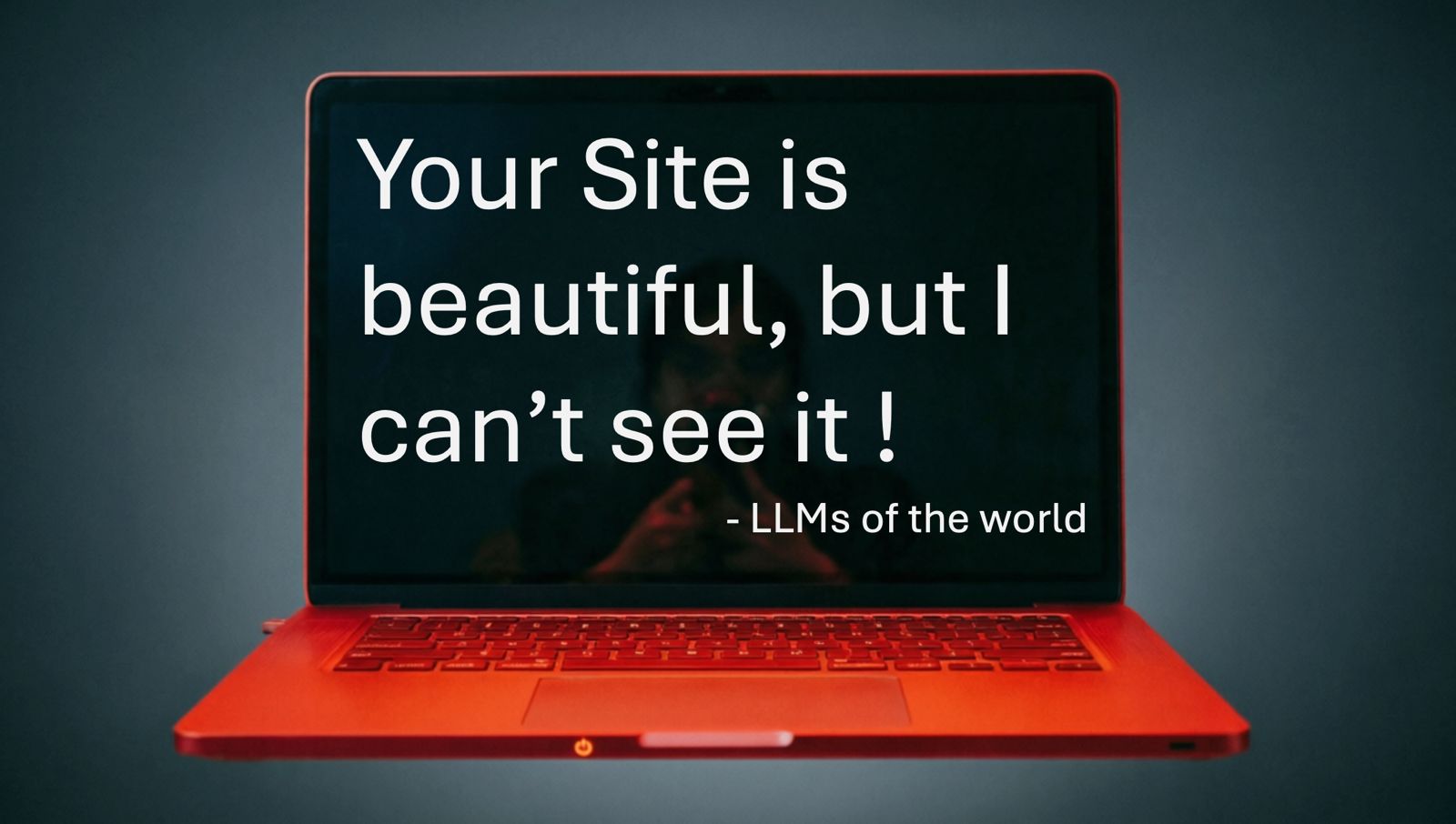
And Why It Changes Everything for Your Brand
Imagine two very different users navigating your website: A visually impaired shopper relying on a screen reader to “see” your products. And a conversational AI—like ChatGPT, Gemini, or Perplexity—scanning your pages to answer someone’s query: “Where can I find comfortable navy slide sandals with a luxury feel?”
At first glance, they seem worlds apart. But here’s the truth: they both experience your site the same way—through text.
Screen readers vocalize alt-text to help humans understand images. AI agents parse that same alt-text to “see,” categorize, and recommend your products in zero-click answers, voice responses, and AI overviews.
In essence: LLMs discover your content the way blind users do—through rich, descriptive metadata.
The richer your image descriptions—the more accurately both groups can understand what you offer, trust its relevance, and choose it over competitors.
The Missed Opportunity: Alt-Text as an Afterthought
For over a decade, most brands treated alt-text as a compliance checkbox—using bare-minimum labels like “black shirt” or “handbag” just to pass accessibility audits or satisfy basic SEO.
That approach worked (barely) in a keyword-driven world. But it fails catastrophically in 2026, where discovery is conversational, contextual, and increasingly mediated by AI.
Today, image-rich e-commerce hinges on nuance: material, color tone, texture, lifestyle context, use case, and emotional resonance. Without these details, your product is invisible—not just to screen readers, but to the AI systems now driving traffic.
The Stakes Are Higher Than Ever
AI-powered search is no longer experimental—it’s dominant:
- Google’s AI Overviews appear in over 50% of U.S. searches
- AI referral traffic has surged over 500% year-over-year in some retail sectors
- Nearly 40% of all searches are now voice or conversational
Yet adoption of AI-ready metadata remains shockingly low—often under 10% in fashion, beauty, and home goods.
This gap creates a rare, first-mover advantage: brands enriching image metadata now are already seeing:
- 2–4X greater visibility in AI-generated answers
- Up to 216% higher conversion rates from AI-sourced traffic
- Dominant citation positioning before competitors even realize the game has changed
Delay, and you’ll face steep catch-up costs as AI “authorities” solidify—and your products vanish into irrelevance in zero-click environments where 60%+ of searches end without a single site visit.
The Solution Isn’t Hard—It’s Scalable
The good news? This isn’t about rebuilding your site. It’s about enriching what’s already there.
Start with alt-text that tells a story:
❌ “Navy slides”
✅ “Men’s slide sandals in navy pebble-textured leather, featuring a cushioned footbed lined with charcoal Signature Canvas—perfect for weekend errands, travel, or warm-weather ease.”
This single line serves two critical audiences at once:
- A blind shopper who now knows the material, comfort, and style
- An AI that can confidently recommend your product in response to “luxury men’s slides for summer”
For brands accessibility may or may not be at the top or their priorities, showing up on LLM search must be one of their biggest bets in 2026, There is once in a lifetime opportunity of turning a compliance burden into a competitive moat.
The Bottom Line
In the age of AI assistants and inclusive design, the most discoverable site is the one that’s best described.
Brands that optimize image metadata for both people and machines won’t just meet accessibility standards—they’ll dominate the next era of search, commerce, and customer trust.
The future of discovery is descriptive. And it starts with a single line of text.
Data points reflect aggregated industry trends from sources including BrightEdge (2025), SimilarWeb AI Traffic Report (Q4 2025), and Google Search Quality Evaluator Guidelines. Conversion uplifts based on early adopter case studies in premium apparel and accessories.