Answer Engine Optimization (AEO) Architecture
Why Retailers Must Shift from Off-Site Forum Buzz to First-Party Canonical Truth in the Age of Generative Commerce?
In recent industry roundtables and retail executive summits, a recurring narrative has taken hold: retail leaders proudly pointing to vibrant Reddit discussions, Subreddit brand mentions, and viral forum threads as proof of their enterprise’s readiness for Generative AI search. The prevailing logic seems intuitive at first glance—if consumers are talking about a brand across public forums, Large Language Models (LLMs) will naturally ingest these mentions and recommend their products to prospective buyers.
However, this strategy represents a fundamental misunderstanding of how modern retrieval-augmented generation (RAG) engines, AI agents, and foundational commercial models ingest, weigh, and verify product knowledge. Community forums do not serve as primary source attributes for LLMs—they serve as validation layers.
The Fundamental Paradigm Shift
Forums validate claims; they are not the source of truth. When an AI agent performs a product synthesis for a high-intent shopper, it extracts core product specifications, dimensions, materials, and compatibility from structured, first-party enterprise sources. Relying on forum chatter to educate LLMs about your catalog is like relying on street gossip to draft a legal contract.
The Core Thesis: Verification vs. Extraction
Large Language Models operate under strict confidence thresholds when answering transactional user queries (e.g., “Find me a non-toxic, hypoallergenic memory foam mattress under $1,200 compatible with adjustable bases”). When synthesizing a response, the model’s parametric knowledge and real-time retrieval system evaluate candidates through a strict hierarchy of trust:
First-Party Canonical Ground Truth (Deterministic): Structured product catalogs, Schema.org markup, official API endpoints, and direct product specifications published by the brand. This provides high-density facts (99%+ confidence).
Third-Party Validation & Sentiment (Probabilistic): User reviews, Reddit discussions, expert blogs, and community forums. This provides sentiment, real-world consensus, and context validation (50%–70% confidence).
If an LLM cannot ground its answer in deterministic, structured first-party data, it faces hallucination risk. Consequently, it will either omit the brand entirely or relegate it behind competitors whose enterprise schemas are explicitly defined. Forum mentions confirm that a brand exists and is liked, but first-party data teaches the LLM what the brand actually sells.
The Impact Weighting Model Framework
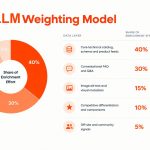
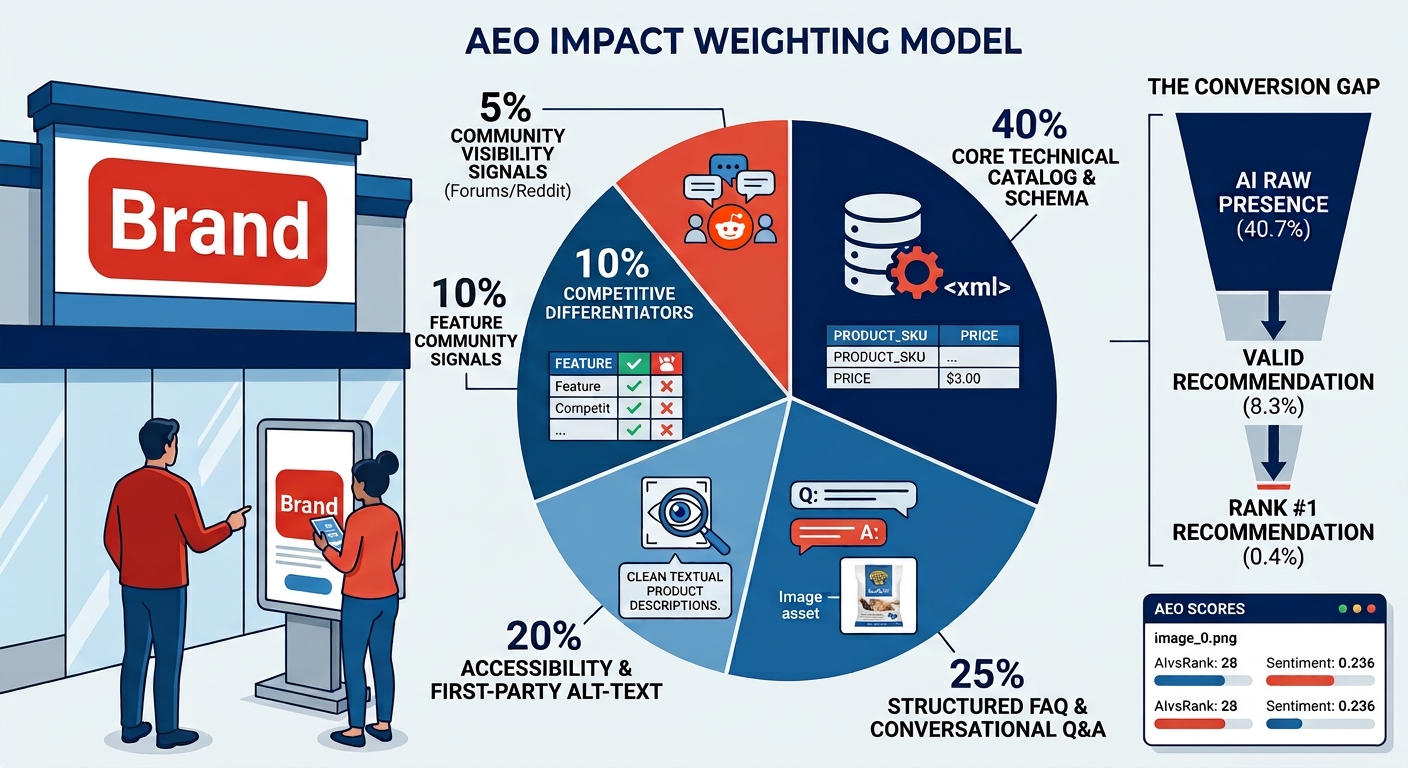
To give retail executives and Answer Engine Optimization (AEO) practitioners a structured blueprint for resource allocation, we introduce the Impact Weighting Model. This framework quantifies where brands must focus their technical and content investments to maximize visibility across AI discovery engines like ChatGPT, Perplexity, Gemini, and custom retail purchasing agents.
| Weight | Pillar | Primary LLM Ingestion Role |
|---|---|---|
| 40% | Core Technical Catalog & Schema | Establishes authoritative ground truth, product attributes, pricing, variants, and real-time inventory status. |
| 25% | Generative FAQ & Conversational Q&A | Provides semantic mapping for long-tail customer intent, usage contexts, edge cases, and natural language queries. |
| 20% | Accessibility & Image Alt-Text | Converts visual attributes into structured DOM text usable by all LLMs (text-only and vision-capable alike). |
| 10% | Competitive Differentiators | Defines explicit positioning, feature-matrix trade-offs, and target audience alignment against category alternatives. |
| 5% | Off-Site & Community Signals | Validates market consensus, authenticates social proof, and reinforces sentiment scores. |
Detailed Breakdown of Model Pillars
40% WEIGHT1. Core Technical Catalog & Schema Markup
This is the bedrock of Generative Commerce. Modern LLM crawlers parsing enterprise web domains look for rich, error-free JSON-LD markup adhering to ProductGroup, Product, Offer, and MerchantReturnPolicy schemas. When technical attributes—such as exact dimensions, materials, care instructions, compatibility standards, and GTINs—are structured explicitly, AI engines ingest them with maximum confidence scores. Without this foundation, your brand is effectively invisible to autonomous buying agents.
25% WEIGHT2. Generative FAQ & Conversational Q&A Structure
Shoppers do not query conversational AI engines using traditional keyword search strings; they ask complex, conditional questions. Generative FAQ optimization involves structuring product pages with natural language question-and-answer pairs that model real buyer decision trees. By proactively answering questions regarding warranty claims, sizing nuances, specific environment performance, and maintenance on-site, you directly inject canonical answers into the LLM’s RAG retrieval pipeline.
20% WEIGHT3. Accessibility & Image Alt-Text Architecture
Image metadata—specifically descriptive alt text, title attributes, and structured image schema—serves as a primary bridge between visual assets and text processing systems. Because metadata is exposed as standard structured text directly within the DOM, any LLM (whether text-only or vision-capable) can read, index, and query your visual product attributes without needing to process a single image pixel.
Structuring rich accessibility metadata fulfills a dual operational objective: it maintains strict ADA compliance while ensuring text-based RAG pipelines ingest visual nuances—such as tactile textures, subtle color gradients, product scale, and design geometry—that standard spec tables omit. For vision-capable models, this metadata acts as a deterministic ground truth that validates their visual feature extraction with higher confidence.
10% WEIGHT4. Competitive Differentiators & Direct Comparisons
When users ask AI models to compare two or three competing brands, the engine searches for structured comparative matrix data. If your site lacks first-party content detailing why your material choices, manufacturing processes, or warranty terms differ from market standards, the LLM will fill in the blanks using third-party assumptions or competitor marketing. Owning your comparative narrative ensures fair representation during AI evaluation stages.
5% WEIGHT5. Off-Site & Community Signals (Reddit, Forums, Social)
While community discussions on Reddit, forums, and niche blogs are valuable for sentiment verification, they account for only 5% of direct structural impact in product attribute ingestion. Off-site mentions validate whether real humans agree with your claims. However, relying on user-generated forum content to define your product’s technical attributes exposes your brand to unverified claims, outdated pricing, missing specifications, and inaccurate product descriptions.
Strategic Imperatives for Retail Leadership
Retail leaders who mistake off-site buzz for foundational AI engine optimization risk building their digital strategy on quicksand. To capture market share in the emerging conversational commerce ecosystem, executives should implement three key shifts:
- Audit First-Party Machine Readability: Evaluate your store’s JSON-LD schema coverage across every SKU. Ensure that 100% of physical attributes, specifications, and offer data are exposed in clean, machine-parsable formats.
- Shift Budget from Pure Social Listening to Structured AEO: While monitoring Reddit sentiment remains useful for PR and product feedback, reallocate technical resources toward building structured Q&A data layers and multimodal alt-text assets directly on your domain.
- Establish First-Party Authority: Treat your enterprise website as the ultimate single source of truth for AI agents. When AI models learn about your product line, they should learn directly from your official technical documentation—not from a random forum comment written three years ago.
Executive Summary Takeaway
Community forums provide sentiment validation, but first-party structured catalogs supply foundational knowledge. Winning in the era of Generative Commerce requires a 95% focus on owning your domain’s structured data, conversational architecture, accessibility/metadata assets, and comparative messaging—leaving off-site signals to fulfill their true role: secondary validation.