AI Discovery
Most product catalogs were built to be filtered and ranked. AI answer engines don’t rank. They read, decide what to trust, and write one answer. If your product isn’t in that answer, there is no page two.
uEnrich by unBound AI | 7 min read | October 2026
That changes the question merchandising and e-commerce teams should be asking. It is no longer “how do we rank?” It is “which parts of our product data actually get a SKU into the answer?” Not every data layer pulls equal weight, and most teams can’t enrich everything at once.
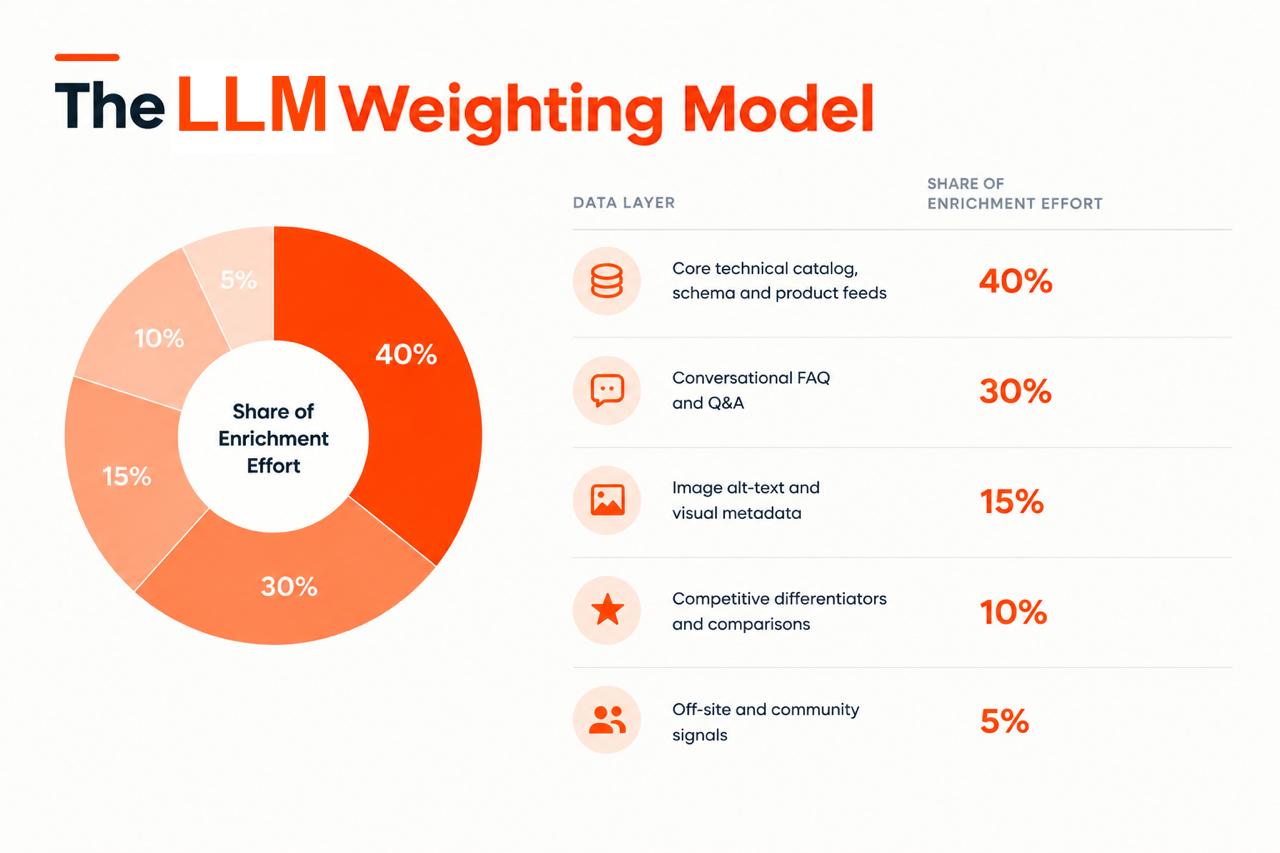
At uEnrich, we use a simple weighting model to decide where enrichment effort goes first. Here it is, along with the evidence behind each layer and the places where the industry data surprised us.
The Weighting Model
The brand tells the story; third parties validate it.
| Weight | Data Layer | Why It Earns the Share |
|---|---|---|
| 40% | Core technical catalog, schema and product feeds | The foundation. Taxonomy, materials, dimensions, compatibility and safety attributes let an engine satisfy hard constraints in a query. |
| 30% | Conversational FAQ and Q&A | Mirrors how people actually ask: long-tail, intent-led questions such as “Is this safe for kittens?” or “Is it flushable?” |
| 15% | Image alt-text and visual metadata | Grounds multimodal and visual search, and reinforces attributes that only appear in images. |
| 10% | Competitive differentiators and comparisons | Gives the engine a reason to recommend this SKU over a named alternative in buying-stage queries. |
| 5% | Off-site and community signals | Validation, not the story. AI engines cite Reddit and reviews heavily, but that content is uncontrolled and can be wrong. Monitor it; keep your own data authoritative. |
These weights show where enrichment effort should go, not a disclosed AI ranking algorithm. They reflect uEnrich’s enrichment experience and the public research below.
Why Each Layer Earns Its Weight
40%1. Core catalog, schema and feeds
AI shopping is increasingly feed-driven, not crawl-driven. ChatGPT Shopping ingests a structured merchant feed defined by OpenAI’s Product Feed Spec, with fields for identity, pricing, availability and variants. If an attribute isn’t in your structured data, the engine can’t match it to a constraint like “under 2 lbs” or “BPA-free.”
This is also the layer that keeps every other layer honest. When a Reddit thread and your spec sheet disagree, a clean, consistent catalog is what lets the engine resolve the conflict in your favor.
30%2. Conversational FAQ and Q&A
People ask AI assistants full questions, not keywords. Q&A content written in the shopper’s own words gives the engine a ready-made passage to retrieve and quote.
The research backs the format. The GEO study from Princeton and IIT Delhi (KDD 2024) found that adding statistics, quotations and cited sources lifted a page’s visibility in generative answers by up to 40%. Keyword stuffing did not help. Specific, factual answers are what get reused.
15%3. Image alt-text and visual metadata
Multimodal agents and visual search tools use alt-text and image metadata to understand what a product looks like and how it’s used. It matters most for visually driven categories like apparel, furniture and decor. Treat it as reinforcement for attributes that also live in your structured data, not as a standalone channel.
10%4. Competitive differentiators
When a shopper asks “X or Y?”, the engine needs an explicit reason to pick one. Clear, verifiable differentiators (certifications, warranty terms, measured performance) give it that reason. Vague superlatives give it nothing.
5%5. Off-site and community signals
This layer validates the story; it shouldn’t tell it. AI engines do cite community content heavily. A Peec analysis of 30 million citations (March 2026) ranked Reddit the most-cited domain across ChatGPT, Google AI Mode, Gemini, Perplexity and AI Overviews, and Ahrefs data from July 2026 puts it at 16.7% of ChatGPT’s citations.
30M
citations analyzed by Peec; Reddit ranked #1 across five AI engines
16.7%
of ChatGPT’s citations point to Reddit (Ahrefs, July 2026)
But community content is uncontrolled. Threads can be outdated, anecdotal or simply wrong, and an engine that leans on them can repeat those errors as fact. You can’t write this layer, so you shouldn’t build your story on it. Monitor what’s said, correct misinformation through your own content, and make your on-site data the thing third-party voices confirm.
Part of Reddit’s dominance is a symptom of thin brand content. When a page for yoga leggings doesn’t say whether they’re squat-proof, or a page for a primer doesn’t say whether it’s fragrance-free, the engine finds the answer in a thread instead. Enrichment closes those gaps and should pull factual queries back to the brand. Opinion queries, like “is it worth it?” or “X or Y?”, will stay with third parties, and they should: engines cross-check a brand’s claims the way a careful shopper does.
The goal isn’t to replace the community. It’s to own the facts, so the community confirms your story instead of filling in for it.
Where to Start
Start with the layers you control, then close the gap with the ones you don’t.
- Audit your top 50 SKUs for missing hard attributes: materials, dimensions, compatibility, safety flags. Fix the feed before anything else.
- Pull real customer questions from support tickets, reviews and site search. Turn the top ten per category into on-page Q&A.
- Rewrite alt-text on hero images to describe the product, its use and its key visible attributes.
- Write two or three verifiable differentiators per hero SKU, framed against the alternatives shoppers actually compare.
- Search Reddit and review sites for your brand and category. Note what people get wrong and correct it in your own content.
Then measure. Ask the major assistants the questions your customers ask, and track whether, and how, your products appear.
The Takeaway
In AI search, the product with the clearest, most consistent, most corroborated data tends to win the answer. Structure comes first, conversation comes second, and outside validation decides the close calls.
How is your team prioritizing product data for AI discovery? I’d like to hear what’s working, and what isn’t, in the comments.
uEnrich by unBound AI helps e-commerce teams enrich product catalogs for answer engines. Learn more about uEnrich.