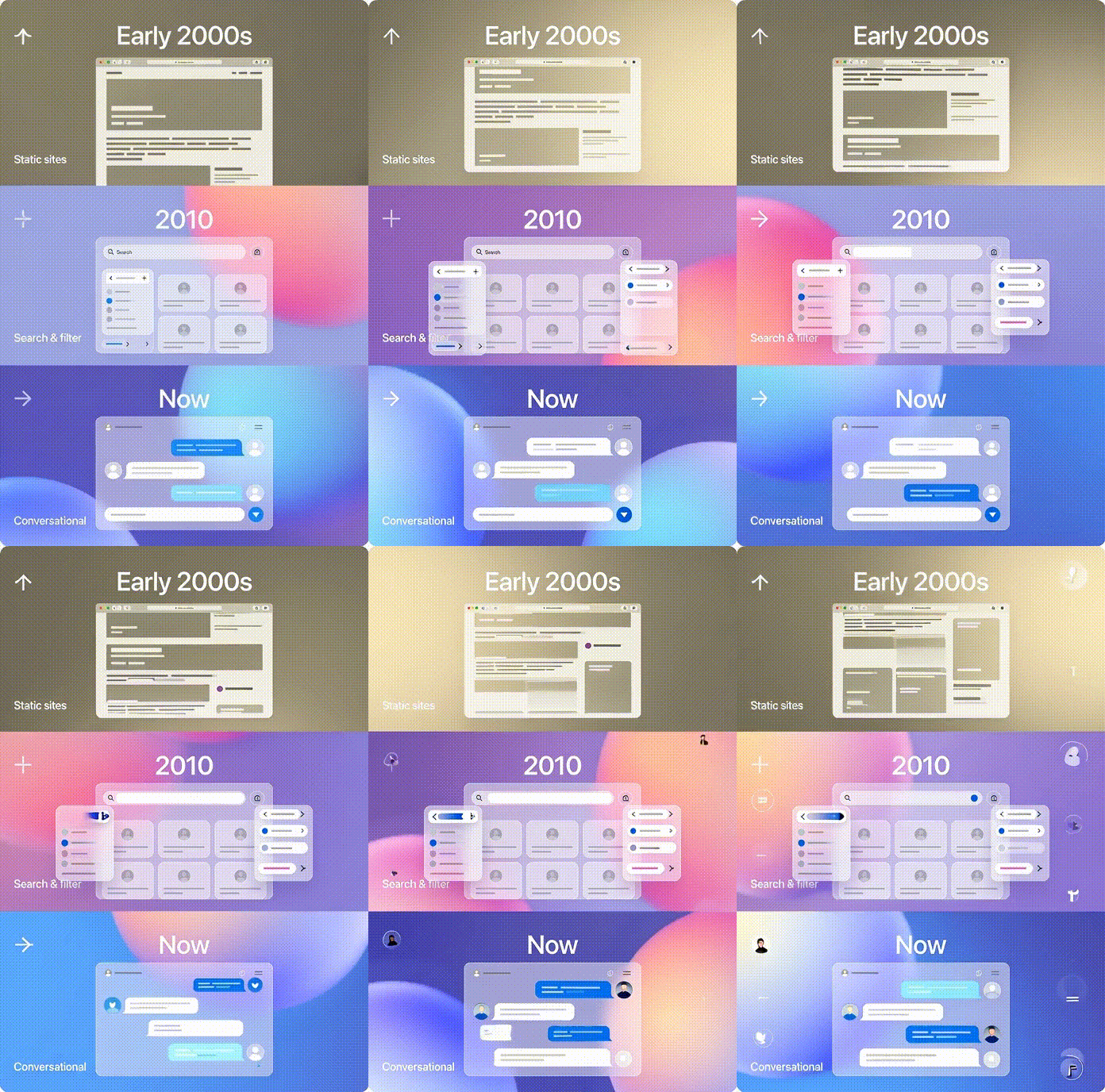
Remember the last time you called a company, navigated a labyrinthine phone menu, and finally, desperately, punched “0” for an operator? For decades, the web has felt eerily similar. We’ve been conditioned to “browse”—to click through menus, sift through FAQ pages, and use search bars with cryptic keywords, hoping to stumble upon the answer we need.
But a fundamental shift is underway. The era of browsing is giving way to the age of asking. Today’s users, especially the digitally-native generations, don’t have the patience for digital scavenger hunts. They expect to ask a question in their own words and receive a direct, immediate answer. They don’t want to navigate; they want to converse. This is the heart of the conversational web, and it’s quickly becoming the baseline for a successful online presence.
What is a “Conversational Digital Asset”?
At its core, a conversational digital asset is any piece of your online content—be it your entire website, a knowledge base article, a product catalog, or a PDF guide—that can understand and answer user questions in natural language.
Think of it as transforming your static website into a patient, infinitely knowledgeable expert. Instead of forcing a user looking for “a durable laptop for graphic design under $2,000” to:
- Go to the “Computers” section.
- Filter by “Laptops.”
- Filter by price.
- Manually scan specs for GPU and RAM.
They can simply type or speak that exact question and get a curated list of suitable products with a justification for each recommendation.
Crucially, this is not a chatbot.
This is the most important distinction to make. Traditional rule-based chatbots operate on pre-built scripts and decision trees. They can only answer questions they’ve been explicitly programmed for. Ask them something outside their narrow path, and you get the dreaded “I’m sorry, I didn’t understand that.”
A truly conversational interface, powered by modern AI, is dynamic. It uses a combination of Large Language Models (LLMs) and a technology called RAG (Retrieval-Augmented Generation) to understand the intent behind your question, search through all of your website’s content in real-time, and synthesize a unique, accurate, and grounded answer. It’s not pulling from a script; it’s reasoning with your data.
Why the Tipping Point is Now
This isn’t a distant, sci-fi concept. Several powerful forces are converging to make the conversational web a commercial imperative today.
1. The unforgiving user expectations have been permanently reshaped. Younger, digitally-native generations are now dominant consumers and decision-makers. This is a mobile-first cohort raised on voice assistants, with an attention span forged in the fires of instant messaging and short-form video. The “attention economy” is real; if you can’t provide an answer in seconds, a competitor’s site will. Bounce rates are a direct reflection of user frustration, and a conversational interface is the most powerful antidote.
2. The technology has finally matured for years, the promise of AI conversation was ahead of the reality. Early implementations were often gimmicky and unreliable. That has changed. The rise of sophisticated, cost-effective LLMs provides the “brain” for understanding nuanced language. More importantly, the RAG framework provides the “memory” and “fact-checker.”
RAG works by taking a user’s question, querying a vector database of your company’s unique content (your website, help docs, product manuals, etc.), and feeding that specific, relevant information to the LLM to formulate an answer. This solves the two biggest problems of early AI: hallucinations (making things up) and generic responses. The result is an AI that speaks in your brand’s voice, based solely on your truthful data. The technology is now robust, accessible, and ready for primetime.
Real Impact: What Changes When Your Site Talks Back?
Adopting a conversational interface isn’t just about keeping up with a trend; it’s about unlocking tangible business value across every department.
- Faster, Scalable Support: Imagine deflecting a significant portion of your routine support tickets without a single human agent. A conversational website can handle common questions about shipping, returns, product specs, and business hours instantly, 24/7. This frees your human support team to tackle complex, high-value issues, improving both efficiency and job satisfaction.
- Higher Conversion Rates: E-commerce cart abandonment is often a result of unanswered questions. “Does this fit true to size?” “What’s the exact delivery date to my postcode?” “Is it compatible with my existing device?” A conversational interface on a product page can answer these micro-questions in the moment, removing the friction that kills a sale. It acts as the world’s most informed and persistent sales associate.
- Dramatically Reduced Bounce Rate: A high bounce rate often means visitors aren’t finding what they need. A conversational search bar is the ultimate guide. Instead of leaving in frustration, users engage in a dialogue. They stay on your site longer, explore more content, and develop a positive association with your brand as one that is helpful and easy to work with.
- Uncovering Hidden Gold: Every question asked to your conversational interface is a data point. It reveals what your customers are truly thinking, what they find confusing, and what information is hard to find. This is invaluable qualitative feedback that can inform your content strategy, product development, and website design.
The Future is a Dialogue
The static, one-way website is a relic of the early internet. It was a digital brochure in an era where that was enough. Today, your website is your front door, your support desk, your sales floor, and your brand ambassador. Making it conversational isn’t about adding a gadget; it’s about fundamentally re-architecting it to meet the modern user on their own terms.
The shift from browse to ask is already here. The question is no longer if you should adapt, but how quickly you can transform your digital assets from monologues into conversations. The businesses that do will be perceived as responsive, helpful, and cutting-edge. Those that don’t will be seen as the digital equivalent of a busy signal.